Atomic Mass Units (amu): A Complete Beginner's Guide with Examples
What exactly is an atomic mass unit, and why does it matter? If you've ever looked at the periodic table and wondered what those decimal numbers under each element's symbol actually mean, you're about to find out. In this guide, we'll break down atomic mass units into simple, digestible concepts — no PhD required.
What Is an Atomic Mass Unit?
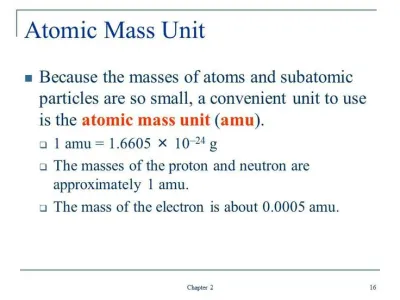
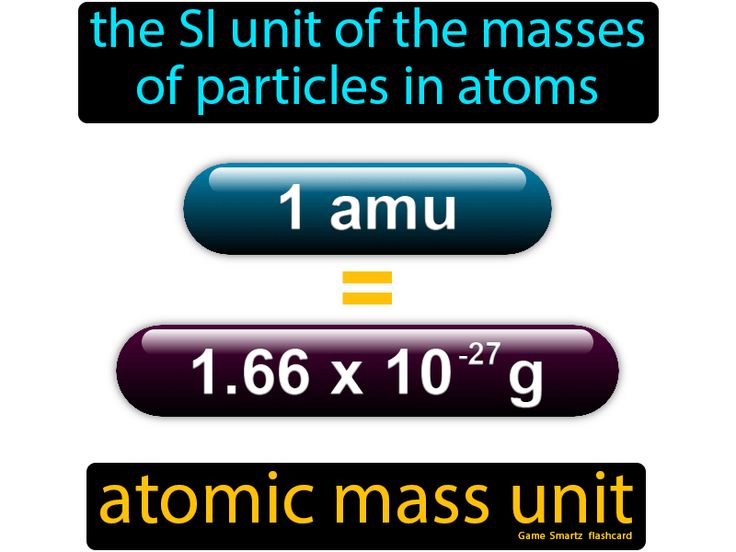
An atomic mass unit (amu) — also called a unified atomic mass unit (u) or dalton (Da) — is a standard unit of mass used to express the masses of atoms, molecules, and subatomic particles.
To put it simply: it is a very, very small unit of measurement designed for very, very small things.
One atomic mass unit (1 amu or 1 u) is defined as exactly one-twelfth (1/12) of the mass of a single carbon-12 atom in its ground state.
Carbon-12 is the isotope of carbon that contains 6 protons and 6 neutrons. Scientists chose this as the standard because it is stable, abundant, and easy to reproduce in laboratories worldwide.
Why Do We Need Atomic Mass Units?
Imagine trying to weigh an atom using grams or kilograms. The numbers would be impossibly tiny and difficult to work with.
For example:
- The mass of a single proton is approximately 0.0000000000000000000000000016726 grams.
- The mass of a single electron is about 0.00000000000000000000000000000091 grams.
These numbers are so small that they are practically useless for everyday chemistry and physics calculations. Atomic mass units solve this problem by giving scientists a convenient, human-friendly scale to work with.
The Relationship Between amu, Protons, and Neutrons
Here is one of the most useful rules of thumb in chemistry:
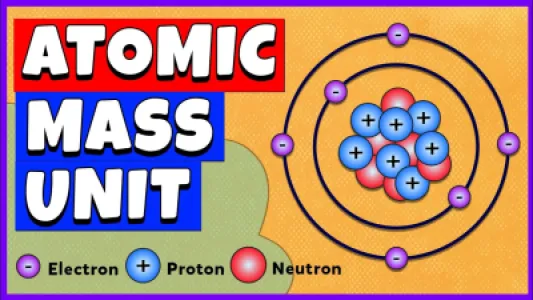
1 proton ≈ 1 amu 1 neutron ≈ 1 amu 1 electron ≈ 0.0005 amu (essentially negligible for most calculations)
This means you can estimate the mass of any atom simply by counting its protons and neutrons:
$$\text{Approximate atomic mass} \approx \text{Number of protons} + \text{Number of neutrons}$$
This sum is also known as the mass number (A).
Quick Example: Helium
- Helium has 2 protons and 2 neutrons.
- Approximate mass = 2 + 2 = 4 amu.
- The actual atomic mass of helium on the periodic table is 4.0026 u — very close!
The tiny difference comes from binding energy (mass converted to energy that holds the nucleus together, described by Einstein's $E=mc^2$) and the slight mass differences between protons, neutrons, and the carbon-12 standard.
Exact Masses of Subatomic Particles in amu
| Particle | Mass (amu) | Charge |
|---|---|---|
| Proton | 1.007276 u | +1 |
| Neutron | 1.008665 u | 0 |
| Electron | 0.00054858 u | −1 |
Notice that protons and neutrons are not exactly 1.0000 amu — they are slightly more. But for most educational and general chemistry purposes, rounding to 1 amu each is perfectly acceptable.
Atomic Mass vs. Mass Number: Don't Confuse Them!
Students often mix these two terms up. Here's the clear difference:
| Term | Definition | Example (Carbon-12) |
|---|---|---|
| Mass Number (A) | Total number of protons + neutrons (a whole number) | 12 |
| Atomic Mass | Actual weighted average mass of an element's naturally occurring isotopes, measured in amu (usually a decimal) | 12.011 u |
Carbon's atomic mass on the periodic table is 12.011 u, not exactly 12. Why? Because on Earth, carbon exists as a mixture of isotopes: mostly carbon-12 (98.9%), some carbon-13 (1.1%), and trace amounts of carbon-14. The atomic mass is a weighted average of all these.
How to Calculate Atomic Mass from Isotopes
This is a classic problem in chemistry classes. Here's how it works:
Formula: $$\text{Atomic Mass} = \sum (\text{isotope mass} \times \text{natural abundance})$$
Worked Example: Chlorine
Chlorine has two main isotopes:
- Chlorine-35: mass = 34.96885 u, abundance = 75.76% (0.7576)
- Chlorine-37: mass = 36.96590 u, abundance = 24.24% (0.2424)
Calculation: $$\text{Atomic Mass} = (34.96885 \times 0.7576) + (36.96590 \times 0.2424)$$ $$\text{Atomic Mass} = 26.492 + 8.961 = 35.453 \text{ u}$$
This matches the value on the periodic table: 35.45 u. The unit is atomic mass units.
Converting Between amu and Grams
For advanced calculations, you sometimes need to convert atomic mass units into grams. The conversion factor is:
1 amu = 1.660539 × 10⁻²⁴ grams
This number is derived from Avogadro's number ($6.022 \times 10^{23}$) and the definition of a mole. Specifically, one mole of carbon-12 atoms (which has a mass of exactly 12 grams) contains Avogadro's number of atoms. Dividing 12 grams by Avogadro's number gives you the mass of one carbon-12 atom in grams, and dividing that by 12 gives you the mass of 1 amu in grams.
Why This Matters: The Mole Connection
This conversion is the bridge between the atomic scale and the laboratory scale. It allows chemists to weigh out grams of a substance in a beaker and know exactly how many atoms or molecules they are working with.
Key Terms You Should Know
| Term | Meaning |
|---|---|
| Isotope | Atoms of the same element with different numbers of neutrons |
| Mass Number (A) | Protons + neutrons in a nucleus |
| Atomic Number (Z) | Number of protons (defines the element) |
| Molar Mass | Mass of one mole of a substance, expressed in grams per mole (g/mol). Numerically equal to the atomic mass in amu |
| Dalton (Da) | Another name for the atomic mass unit, commonly used in biochemistry and molecular biology |
Summary: The Big Picture
Let's tie everything together:
- Atomic mass units (amu) allow us to measure the mass of atoms on a convenient scale.
- 1 amu = 1/12 the mass of a carbon-12 atom.
- Protons and neutrons each weigh approximately 1 amu.
- The atomic mass on the periodic table is a weighted average of all naturally occurring isotopes.
- 1 amu = 1.6605 × 10⁻²⁴ grams, which connects the atomic world to the laboratory world through the mole.
Final Thoughts
Understanding atomic mass units is one of the foundational skills in chemistry and physics. Once you grasp that protons and neutrons are each about 1 amu, and that the periodic table shows weighted averages, the rest of chemistry — stoichiometry, molar calculations, and reaction balancing — becomes much easier to navigate.
Remember: Chemistry is not about memorizing numbers. It is about understanding relationships — and the atomic mass unit is the bridge between the invisible world of atoms and the measurable world of the laboratory.
Did this guide help clarify atomic mass units for you? Bookmark this page for your next chemistry exam!